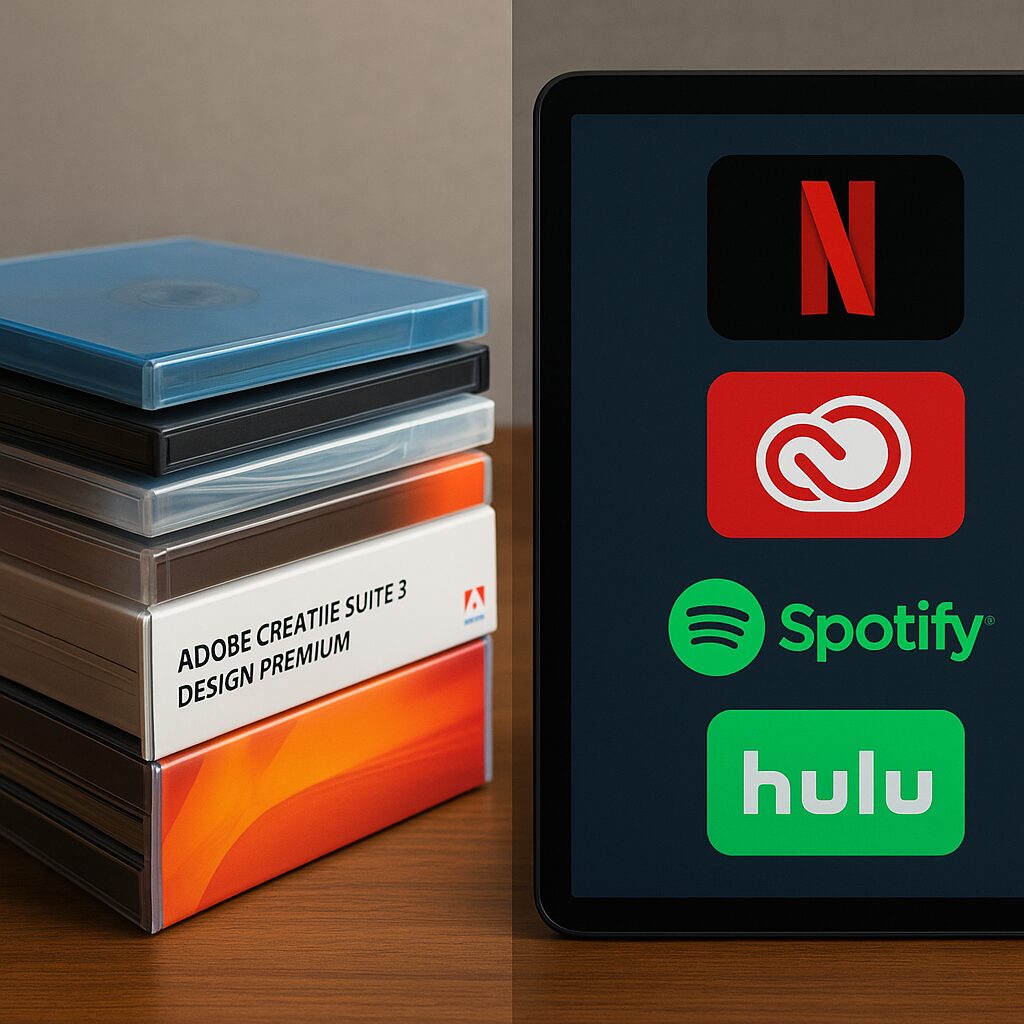
More and more “minimalism” isn’t about simplicity, it’s more about a business model built on chronic subscription revenue.
The rise of the subscription economy
Subscription pricing used to feel like a convenience; monthly payments for streaming services, creative tools or digital games did not seem like a big deal, after all, you get what you need when you need it. But convenience came with a hidden cost of you rarely owning anything.
- Take digital creative software like Adobe, you once could buy a physical copy, install the program and own it forever. Then came the switch to monthly fees and suddenly the software disappears as soon as you stop paying.
- Games followed the same path: physical discs used to represent a type ownership. Now you buy a download for the same price but nothing to hold, nothing to resell if you are done.
- Streaming replaced DVDs, apps replaced CDs and what once was content you possessed became content you rent.
That shift was no accident because companies prefer steady and predictable income. Take Tesla for example, Elon Musk told shareholders they can sell the vehicles at a loss because the real money is within their subscription service. This is why every category is being pushed towards subscription-based access. The result of these actions is a culture where renting beats owning, even when owning would make more sense.
Reshaping of what we value
Owning things made sense when the economy was stable. When a phone, a game console, or a piece of software retains value or at least usefulness for years. In this day there is a list of reasons not to own from:
- Prices are high.
- Products get obsolete quickly.
- The return on investment shrinks.
In an environment like this renting or subscribing starts looking smarter, more convenient and with less upfront cost, less risk carrying obsolete stuff. Why buy a $1,000 phone when you are not guaranteed it will not be bricked in two years and why dump hundreds of dollars into something that might end up collecting dust? That uncertainty fuels consumer minimalism.
If everything is going to be temporary from your phone, your music and your media consumption maybe it makes sense to lighten the load.
Digital identity over tangible ownership
There is a cultural shift happening where we are trading tangible possessions for digital footprints. Life now happens online and you have more ownership there, then in real life. When it comes to online:
- You don’t need to buy a game if you can watch someone else play it.
- You don’t have to pay for a concert when you can stream it.
- You don’t need a physical photo album when you have cloud storage and social‑media galleries.
Our playlists, avatars, opinions, even communities all live digitally and the more comfortable we get in digital space, the less we crave physical ownership. The less we need things, the more we start to believe that having digital access is good enough.
That shift isn’t always by choice in a shaky economy because in some cases digital is cheaper, easier to maintain and more flexible. It’s not about being minimal more so than it being about having some sort of sense of normalcy of having something.
Long term
Maybe this is just how things are going to be now: renting over owning, streaming over buying, access over possession. That doesn’t mean it has to feel normal or acceptable because when ownership disappears, so does control on how you wish to use a product or even if you wish to resell it. This in the long-term results in you becoming permanently forever dependent on a subscription model.
_________________________________________________________________________________________________________________________
Shaunta Garth is a Strategic Communications & Visibility Architect specializing in digital storytelling, media strategy and public affairs.