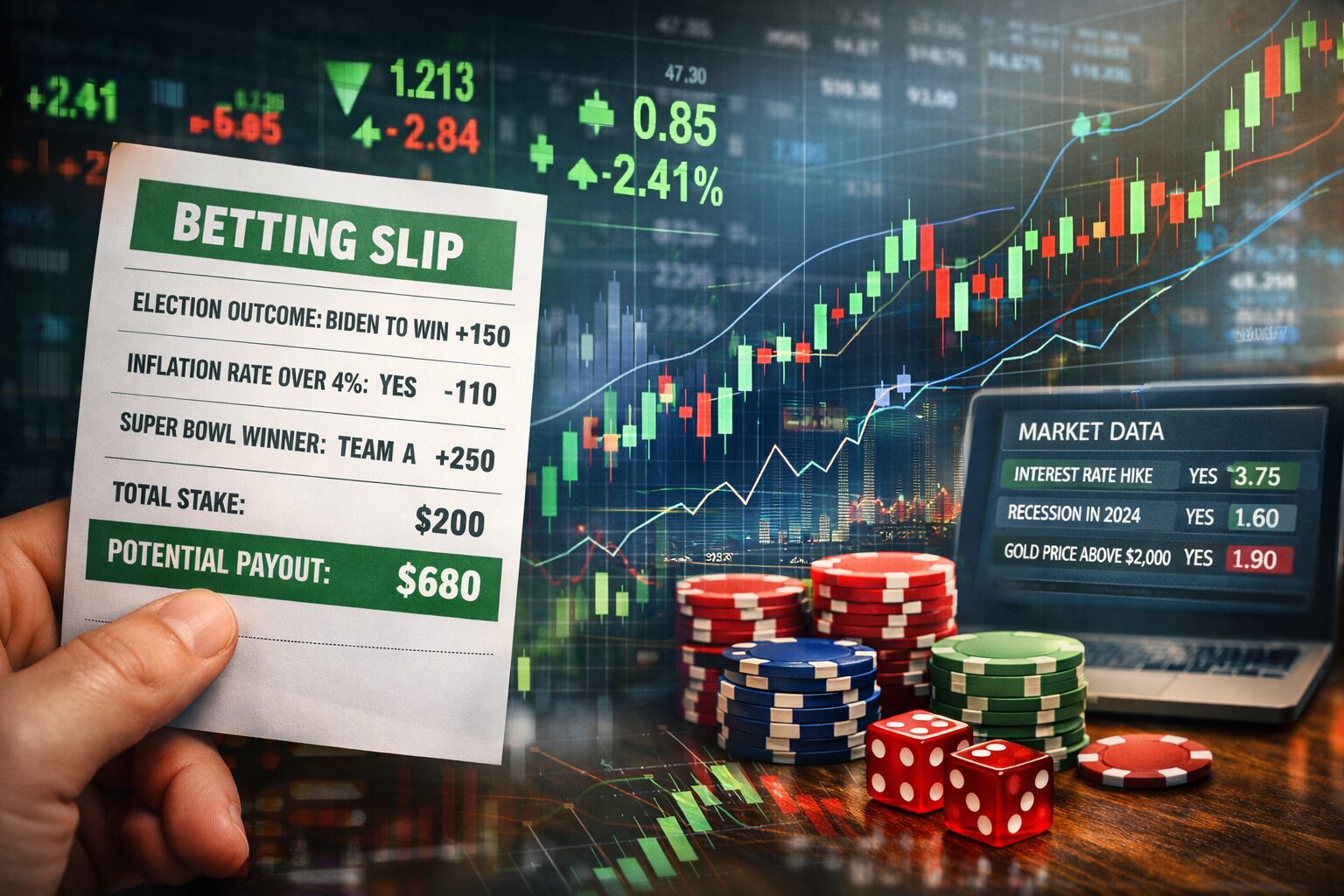
Imagine watching a car speed down a road and from a distance you can see clearly that further ahead there is no road, just a cliff. You stand there wondering if you are the only one who sees it, wondering why nobody is saying anything and why this is being celebrated instead of questioned. That is exactly how I feel watching the prediction markets boom unfold right now.
Prediction markets are platforms where users place money on the outcome of future events, elections, economic indicators and sports results and collect a payout if their prediction is correct. Proponents call it trading, but the legal definition of gambling calls it something else.
Why Is No One Asking Questions?
My attention to prediction markets did not start with any single article. It started with two moments that made me stop and say: wait a minute.
The first was an interview with Tarek Mansour, CEO of Kalshi, one of the largest prediction market platforms operating today. He framed the whole enterprise as an answer to a broken system, a way to finally give everyday people access to markets they had been shut out of. The problem with that pitch is that it was not accurate because apps like Robinhood already exist and there are apps where rounding up your grocery purchase puts that change toward investing. Nobody locked the average person out of financial markets, so when someone shows up saying they are solving a problem that does not actually exist, it is worth asking what the reframe is really for.
The second moment came from Benzinga’s March 2026 reporting on Mansour’s remarks at the FIA Global Cleared Markets Conference in Florida. According to that coverage, 95 percent of Kalshi’s customers avoid traditional financial markets because they believe the system is stacked against them and Mansour said his customers trade on Kalshi because they believe they have a real edge on inflation, politics and sports in a way they never could on the S&P 500.
Is Predicting Just a Cleaner Word for Betting?
The industry argument goes like this: prediction markets are not gambling because users trade on probability, the platform collects fees from both sides and the house has no stake in the outcome. That argument is semantics and not particularly careful semantics at that.
The legal definition of gambling in the United States says that a person engages in gambling when they stake or risk something of value upon the outcome of a future contingent event not under their control, upon the understanding that they will receive something of value if a certain outcome occurs. Read that back slowly and then explain how putting money on who wins a presidential election does not meet every element of that definition.
Calling it predicting instead of betting does not change what is happening because you are making a pick on what you think will happen, putting money on that pick and getting paid if you are right. The only meaningful difference is the word used to describe it and that word determines whether the industry owes fifty state gambling licenses or can operate on a single federal charter. The financial stakes of that classification are in the billions, which is exactly why they fight so hard to protect it.
Prediction markets remind me of baccarat, where cards are dealt and you pick between the player or the banker and whichever hand comes closest to nine wins. You have no control over the cards or the outcome and it comes down to the luck of the draw, but the difference is that baccarat has never dressed itself up as something other than what it is to avoid regulation.
Have We Seen This Playbook Before?
This is not the first time a technology industry has used the facilitator argument to sidestep accountability because we lived through this with social media and we watched what happened.
For two decades social media platforms maintained they were neutral spaces where people could come together and share ideas and they said they were not responsible for what users posted or what that content caused in the real world. Section 230 of the Communications Decency Act gave them the legal protection to hold that position and the result was two decades of unchecked growth while hate speech spread, misinformation became impossible to contain and the mental health of an entire generation quietly came apart.
Prediction markets are working from the same playbook where users trade against each other and not against the platform, which provides the exchange without making the bet. It is the Section 230 argument translated into the language of financial markets. We are watching it at the exact same early stage where the scale is still building. This is the moment to say something because later is always too late.
What Happens Downstream?
There is an effect building here that almost nobody is talking about publicly and a 2026 Fairleigh Dickinson University study found that 25 percent of American men 30 and under wager on sports with 10 percent of that group reporting a gambling problem. Those are numbers for adults and the data does not yet track what is happening with people 18 because we have not been watching long enough. If we do not put real guardrails around prediction markets, particularly around who can access them, we are going to produce a generation of young adults who are financially damaged before they ever had a real chance to start.
Years from now the same companies that built their valuations on that participation will announce funds and restrictions and the news will cover it as accountability, but we have seen that story already and we know how it plays out.
What Decision-Makers Are Not Hearing
You are hearing constantly about the opportunity here, about innovation and market efficiency and democratizing finance, but what you are not hearing enough about is what happens on the other end.
Social media came to us with the same framing because it was going to connect people, spread information and give everyone a voice. What it also produced was misinformation at a scale nobody could contain, coordination of real-world harm, deepfakes used for stalking and an epidemic of adolescent mental illness that took two decades to even be acknowledged. The companies had internal research and they knew what was happening, but they kept going because the money was there and nothing made them stop.
You cannot stand behind the benefits of a technology without owning what it produces on the other end and that is not pessimism or a case for stopping anything.
The Gap Between What Is Said and What Is Happening
I am a communications strategist and what I do professionally is pay attention to the gap between what is being said and what is actually happening. What I see in prediction markets right now is an industry that watched what social media did and learned from it, not in the direction of doing better but in the direction of moving faster than the accountability can catch up.
I am not arguing that prediction markets should not exist. I am arguing that we have been here before, we know what the facilitator argument produces when left unchecked and the cost of waiting to find out again is one we will not be able to refund.
Frequently Asked Questions
Are prediction markets legal in the United States?
It depends on who you ask and which state you are in because platforms like Kalshi operate under a federal charter that classifies their products as financial instruments rather than gambling. Arizona filed criminal charges against Kalshi, while Washington’s attorney general filed a civil suit calling it an illegal gambling operation. A federal judge temporarily blocked Arizona from moving forward at the CFTC’s request. That is not a settled legal question. It is a fight over classification with billions of dollars on the line.
How are prediction markets different from gambling?
The industry argument is that users trade against each other, the platform collects fees from both sides and the house has no stake in the outcome. The legal definition of gambling in the United States says you are gambling when you stake something of value on a future event outside your control with the expectation of receiving something of value if a certain outcome occurs, and prediction markets meet every element of that definition. The only real difference is the word used to describe it, and that word determines the regulatory framework, which is exactly why the industry fights so hard to protect it.
Who is actually using prediction markets?
According to Kalshi’s own CEO, 95 percent of their customers avoid traditional financial markets because they believe the system is stacked against them, so that is not an audience of sophisticated traders. That is an audience of people who already feel burned by the system and are being told this time is different, and targeting people who distrust financial institutions with a product that is legally indistinguishable from gambling is not democratizing finance. It is a reframe worth examining carefully.
Is the prediction market industry following the social media playbook?
That is exactly what concerns me because social media platforms spent two decades arguing they were neutral facilitators not responsible for what happened on their platforms, and they had internal research showing the harm but kept growing anyway. The same facilitator argument is now being used in financial markets at the same early stage, before the scale makes the harm undeniable, and we know how the social media version of this story ends. The question is whether anyone is willing to say something before we get there again.
I am an executive communications strategist with experience in government, media and corporate organizations. I write about AI, the workforce and what responsible communication looks like when technology moves faster than people are ready for.