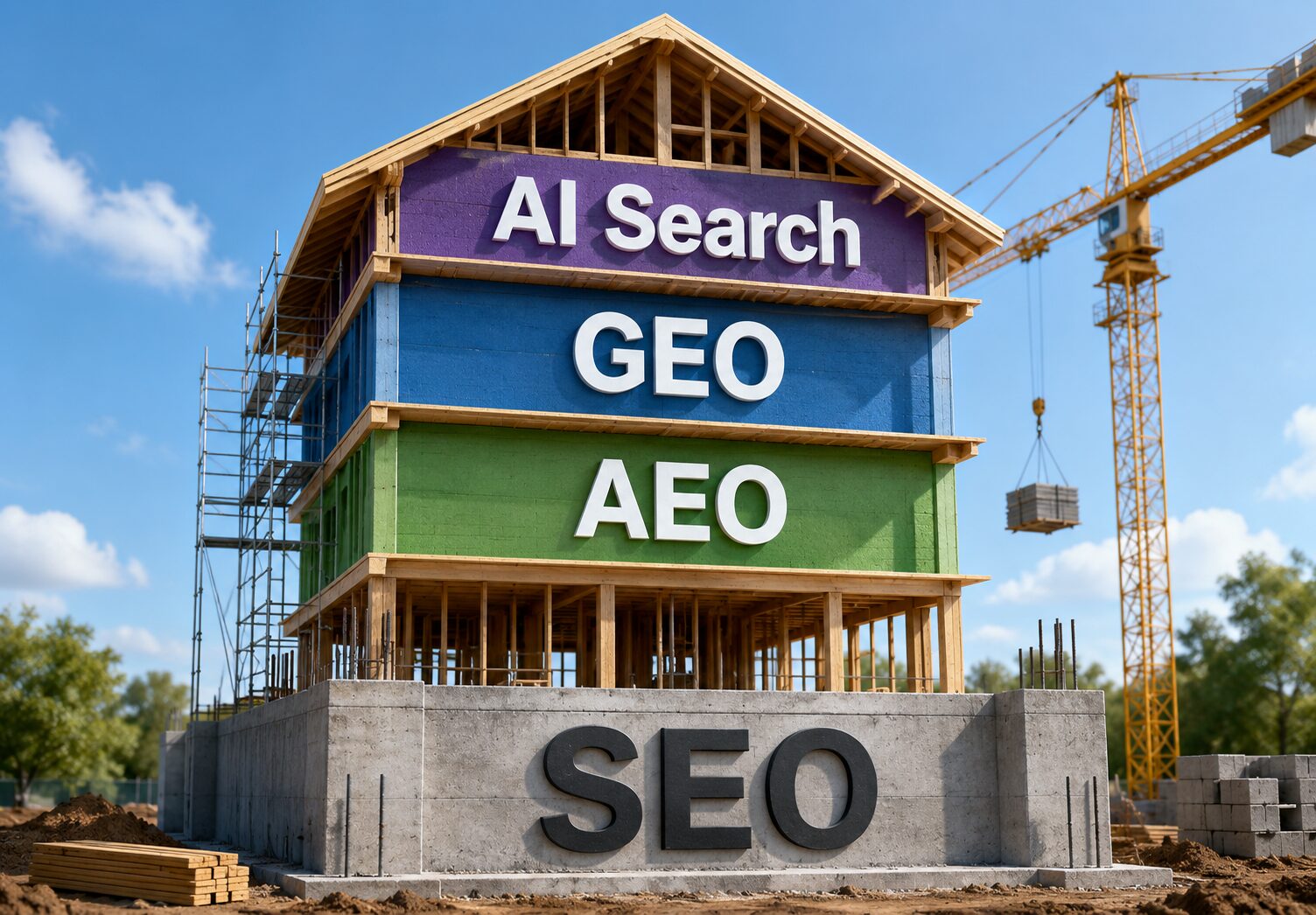
I have been saying this for a while now, that when it comes to AIO, GEO and AEO, you need a strong foundation in SEO. It is not optional and it is the foundation that everything else has to rest on. Building an AI search strategy without SEO is like constructing a house with no foundation; it is going to collapse eventually. The only real question is not whether that happens but when.
Here is the part that most companies tend to miss entirely, which is that the reason your content is not showing up in AI search is not always the content itself. More often it is your structure, it is your silos and it is the simple fact that the people who could actually fix the problem are never in the same room talking to each other.
A silo is when your communications, social media and digital teams all work separately instead of together as one unit. Each one of them does good work on its own, but nobody ever connects that work into a single coherent effort, which means the message breaks apart and it will not reach an LLM.
Why Does SEO Still Matter For AI Search
SEO is the groundwork that allows AI to find you in the first place. Without it you are essentially invisible. If your content was never built to be discovered by search engines, then it is not going to magically register in AI Overviews, in AEO or in any LLM, no matter how good that content happens to be. The work has to happen first, before any AI system can pick it up and carry it forward.
I have been making SEO friendly content for years now, going all the way back to when brands were not even bothering to use SEO at all. That content moves into LLMs easily today, precisely because the foundation was already there and waiting for it. I did the work long before it became mandatory for everyone else. That is the whole point I am trying to make here, because the people who see where things are heading are the ones who build for it early instead of scrambling later.
What Does The Semrush Study Show
It shows that the problem is structural rather than creative, which is an important distinction to understand from the start. Only 22% of US marketers told Semrush that they have a fully integrated AI search and SEO strategy, while the rest of them admitted to some version of a gap. That gap is the silo and it is the reason that so much content never surfaces in AI at all.
Here is exactly why this matters in practice; LLMs are pulling from everywhere all at once, which means your blog, your news articles, your Reddit threads and your YouTube videos are all feeding into the same picture. When your teams are not joined up, you end up saying one thing on social media, another thing on the blog and something else entirely in your press. The AI then sees all of that inconsistency and gets you wrong. Semrush found that the damage from this shows up in very real numbers:
- 37% of marketers said that their competitors were getting mentioned more often than their own brand was.
- 30% said that AI was describing their brand inaccurately.
- 29% said that their positioning was coming across as unclear or generic.
That is what a silo actually costs you and it is not some vague or theoretical penalty either. It is your competitor sitting in your spot, it is your brand being described incorrectly and it is your positioning getting turned into mush.
The Missing Linchpin
The fix starts with bringing in a digital strategist, because the digital strategist is the one who owns the online space entirely. They come from a place of research and data about the online user. This means they understand search habits, what people are actually looking for, how those people want to be spoken to and whether they respond best to video, to audio or to photos. That strategist holds the key to your visibility online, but none of that matters unless you are actually willing to listen to them.
What Integration Looks Like
Look at what HubSpot has done here as a clear example of this working. Their CMO said that they never once treated answer engine optimization as a separate team or a separate strategy. Instead, they treated AI visibility as a natural evolution of search itself, one single approach rather than two competing ones. That decision allowed them to move faster, to skip a great deal of duplicate work, stay consistent across both traditional search and AI. That is essentially the whole argument made real inside one company.
Who Should Own AI Search Inside A Company
The honest answer is that nobody owns it alone. Anyone who tells you otherwise is probably selling something. Communications, social media and digital strategy each own a real piece of this. The work only holds together when all three of them are coordinating with one another. The job is to connect their expertise into something cohesive, not to pick one of them and quietly ignore the rest.
The market has not settled any of this yet, which is worth keeping in mind before you commit to one structure. In the Semrush survey, 18% of companies had a dedicated GEO specialist or team, 16% of them put it inside the SEO department, 15% handed it over to content and 14% chose to share the responsibility across multiple teams. What that really translates to is that most companies are still guessing. Here is how the core roles actually break down once you look at them clearly:
- Communications: They own the message, the tone and the timing, so when they tell you that a message may not land well or that the timing is off, that is their expertise talking and you should treat it that way.
- Social media managers: They own the audience on the social platforms and they genuinely understand how people behave once they are there.
- Digital strategists: They own the online space, the search behavior and the underlying data on how users actually find and then consume content. This individual can help both the Social Media Manager and Communications person because they have the data to tell you who the audience is, what they are looking for and more.
Can one single person be a hybrid across all of these areas? Yes, they absolutely can. A real multidisciplinary is one of the most valuable people you can have in the room. I am one myself, so I know the value firsthand. They understand what marketing needs, what public relations needs, what social media needs and exactly how all of those pieces are supposed to fit together. Here is the trap though, you cannot pile every responsibility onto that one person and call it a strategy, because being a hybrid was never meant to be a one-person department. The smarter move is to hire people who are genuinely proficient in their own field and their own domain, then take honest inventory of the skill set you already have so you know how to actually use it. When you do have a multidisciplinary in the building, let them help and let them spot the gaps, since they are aware of multiple domains at once. They can sit in the comms meeting and contribute, sit in the social media meeting and contribute there too, sit in every meeting and add something real to each one, offering ideas across the board and the messaging cohesion that siloed teams never manage on their own.
How Do You Break Down Marketing Silos
You break down silos by getting communications, social and digital into the same room and onto the same project, rather than leaving them in separate meetings on separate calendars that never overlap. It has to be the same conversation, where they are sharing research with one another and building one consistent plan together that stays on brand from start to finish.
Companies hold meetings all day, every single day, so the idea that there is no time for this simply does not hold up. Those three teams should be meeting together too, coordinating their efforts, sharing their research and keeping the message consistent across every channel that you operate on. When they fail to do that, here is exactly what you end up with:
- You get a different message running in your print materials.
- You get a different message altogether sitting online.
- You get yet another different message playing out on social media.
- You also get a jumbled message, if there is any message at all, inside an LLM, simply because you are not showing up in the first place.
Why You Have To Respect Subject Matter Experts
People who are truly proficient in their field tend to spot trends and shifts early, the exact kind of thing that could prepare your brand for whatever comes next, but they can only do that if you are actually willing to let them work.
For far too many years now, companies have used their people as tools rather than treating them as the experts that they genuinely are. When your communications person tells you that a message will not be received well and you go ahead and do it anyway, the blowback that follows is entirely on you. Failing to respect a person’s skill within their own domain is a real detriment to your brand, which is why you have to hire skilled people, let go of the reins and allow them to be who they are. If you do not do that, you are going to miss the avenues that actually matter.
What Happens If You Stay Siloed
The simple answer is that you disappear entirely. US internet penetration hit 93.1% at the end of 2025, with 324 million people online, according to DataReportal’s Digital 2026 report. That number has climbed every single year for a full decade, up from 74.6% back in 2015. Almost everyone is online now, which means that if your message is fractured across your channels and absent from AI, then your brand is effectively invisible in the one place where it actually counts.
There needs to be a clear understanding, no longer can you operate your brand from inside a silo and expect it to keep working. No longer can you afford to ignore your subject matter experts and the things that they are trying to tell you. No longer can you simply try to do whatever you want and then pay your way out of the consequences, because it is not possible anymore and that is just reality.
Frequently Asked Questions
Do I need SEO for AI search?
Yes, you do. It is honestly not up for debate at this point. SEO is the foundation that everything else is built on top of, so trying to win at AIO, AEO or GEO without it is like building a house with no foundation underneath it. That house collapses eventually. It is not really a matter of whether it happens but rather when it happens. The brands that are showing up in AI right now are the ones who did the SEO groundwork early, long before they ever had to.
What is a digital strategist and why do I need one?
A digital strategist is the person who owns your online space and understands it from the inside out. They work from research and data about how your users actually search, what they are looking for when they do and how they want to be spoken to once you reach them. That role is the linchpin that most companies are missing entirely. It shows in their results. They hold the key to your visibility online, but that only works if you are actually willing to listen to what they tell you.
Why is my content not showing up in AI search?
Very often the issue is not your content at all, it is your silos. LLMs are pulling from your blog, your social, your news and your Reddit presence all at the same time, so if your teams are not joined up, the AI sees that inconsistency and ends up getting you wrong. Only 22% of US marketers have a fully integrated AI search and SEO strategy in place. If you happen to be sitting in the other 78%, then that is very likely the reason you are invisible.
What does a silo actually cost my brand?
It costs you real visibility. The numbers genuinely prove it out. In the Semrush survey, 37% of marketers said that competitors got mentioned more often than they did, 30% said that AI described their brand inaccurately and 29% said that their positioning ended up looking generic. What that means in plain terms is your competitor sitting in your spot and your brand being described incorrectly. A silo is not some small internal headache that you can shrug off, it is lost ground in AI search.
Can one person handle communications, social and digital strategy?
Yes, hybrids do exist. I happen to be one of them myself. I understand communications, digital strategy, marketing, public relations, media and social all at once. But it only ever works if you take honest inventory of what your team actually knows and then let them use it. A hybrid is never an excuse to cut corners or to stop listening to your experts.
How do I get my marketing teams to work together?
You put communications, social and digital into the same room and onto the same project together. It cannot be three separate meetings happening in isolation from one another. It has to be one conversation, where they are sharing research and building one single plan that stays on brand. HubSpot did exactly this, treating AI visibility as an evolution of search rather than as a separate team. That approach allowed them to move faster and to stay consistent. That is the model worth following.
I am an executive communications strategist with experience in government, media and corporate organizations. I write about AI, the workforce and what responsible communication looks like when technology moves faster than people are ready for.