Google has been defining what search looks like for almost 27 years. When something becomes a verb, “just Google it,” it has become infrastructure. When infrastructure changes, everyone downstream has to adjust. The shift to AI-powered search is not a tech story in the way most people are framing it. It is a strategy problem that starts now and will reshape how communicators and marketers plan, research and execute everything going forward.
AI overviews deliver answers directly inside search results, pulling information from across the web and presenting it before a user ever clicks a link. For users, that is a faster experience. For brands that depend on people actually landing on their pages, that is a threat to traffic that is already shrinking and will not recover on its own.
What Is Google’s AI Search Update?
Think about what Google search used to be; you typed something in search, you get links, you pick one. Everyone searching the same thing got roughly the same list. That model is gone. Every search you run on Google is being recorded and used to shape the next one. Your history, your saves and your clicks are all feeding a version of search that is being built around you specifically and the person next to you searching the same phrase is getting a different set of results because their behavior built a different version. For users, that feels like a smarter experience but for communicators and marketers trying to reach people who have never heard of them, it functions like a wall that was built before they ever showed up.
Why Are Clicks and Impressions Dropping?
Traffic has been falling since AI entered search at scale because Google surfaces a summary, the user reads it and moves on and the site that wrote the original content gets the exposure without getting the audience.
Personalization compounds that problem significantly. People were already gravitating toward content they liked and filtering everything else out on their own. Now the algorithm handles that filtering automatically, which means if you were not already inside someone’s content world before this update, breaking in just got considerably harder. Your click-through rate, impressions and engagement numbers are not just declining. They are becoming the wrong metrics to be measuring in the first place.
- AI summaries answer questions before users ever click through to a source, meaning the site that produced the content gets no traffic from the interaction.
- Personalization confirms what people already like rather than introducing them to what they have not seen, which closes off discovery for brands that are not already in the conversation.
- If someone has never searched for you, clicked on you or saved anything connected to you, the algorithm has no reason to surface you to them and that gap becomes harder to close the longer it exists.
What Does This Mean for Marketers?
It means jumping on trends was already a lazy strategy and now it may not produce any meaningful results at all. If a trend is only gaining traction inside a specific algorithmic bubble, it is not a general trend in any meaningful sense. It is a niche signal reaching a self-selected audience that was already predisposed to engage with it and treating that as broad momentum will send your strategy in the wrong direction.
Think about what that does to how you define a trend in the first place. Right now, you can look at a topic gaining momentum and reasonably assume a broad audience is paying attention to it. Going forward, the real question is trending with who, because trending inside one bubble while being completely invisible in another is not traction. It is noise you cannot even measure from the outside.
The communicators who are going to struggle most are the ones who have been relying on surface-level research and calling it a strategy. That approach was already producing diminishing returns before this update arrived and now it is a liability that will cost brands real ground. You cannot reach an audience you have not studied and you cannot break into a bubble you do not understand. Research has to be consistent and specific, not something you revisit when a campaign is already underway and the numbers are not moving.
What Should Brands Focus on Now?
The platform is a moving target, your audience is not. Their needs, questions are what pushes them toward a decision stay relatively consistent regardless of what Google decides to change and a strategy anchored to those things survives updates that would completely dismantle one built around algorithmic behavior.
Stop Chasing Impressions
Impressions, click-through rates and trend riding belong to an era that this update is closing out. The metric that matters now is conversion, meaning how do you take a user who encountered your content inside an AI overview and turn them into someone who visits your site, saves your work or comes back for more. When your content provides real value, the AI overview does not kill the relationship. It starts it, because a useful answer creates a user who wants more information and that want is the conversion path.
Provide Value, Not Volume
The days of posting to stay visible are over. Users have no patience for content that circles the topic without landing on it and they have even less patience for brand content that prioritizes presence over usefulness. If someone is searching for how to make a grilled cheese, the only thing that matters is whether your content tells them exactly how to do it. That same standard of clarity and specificity, applied to whatever your brand actually provides, is the only thing worth putting into the market right now.
Make Research a Consistent Practice
Audience behavior, platform behavior and search behavior are all shifting faster than a quarterly review can capture, which means monthly research is the floor, not a best practice. An audience analysis from six months ago is already working from assumptions that may no longer hold. The communicators who treat research as a one-time deliverable are not behind the curve in any recoverable way. They are already losing ground to people who never stopped doing the work.
How Do You Respond as a Communicator?
Start with an honest internal look at your brand, what you actually provide and whether the value of that is clearly reflected in your messaging. Not the mission statement version, but the practical, specific version a user would care about when they are actively searching for something they need.
- Audit your audience behavior. Where are they actually spending time, what are they saving, what are they following and what are they consistently searching for? You need to understand what bubble they are already operating inside before you can figure out how to reach them within it.
- Stop chasing general trends. A trend that does not exist inside your audience’s specific algorithm is not a trend that serves you. Redirect your attention toward what is actually moving within the communities and spaces your audience already inhabits.
- Build presence where your audience already lives. If Google is going to reinforce existing behavior, your brand needs to already be part of that behavior, which means investing in email lists, direct relationships and community presence that does not depend entirely on search visibility to survive.
- Define your messaging with precision. If you cannot clearly articulate what your brand provides and why someone should care. No amount of posting, trending or optimizing will close that gap. The algorithm does not reward presence. It rewards relevance and relevance starts with understanding your own value well enough to put it into words that make someone do something.
Is This the Future of Search?
The internet has been moving in this direction for longer than most people want to admit. Social media platforms proved that people engage more consistently with content that reflects what they already believe and already enjoy and Google applying that same logic to search is the next logical step. The difference is that it now affects the part of the internet that was still relatively open to discovery.
What we are watching in real time is a shift from a public internet to a collection of personal ones, where each user experiences their own version of search, their own version of discovery and their own algorithmically curated world. Getting in front of those users from the outside is the challenge nobody in marketing has a clean answer for yet and the communicators who close that gap first are the ones who already did the research everyone else skipped.
You do not need to reach everyone. You need to reach the right people and that starts with knowing them well enough to show up where they already are before the algorithm decides you are not relevant to them.
You Cannot Put This on One Person
There is a staffing mistake that has been common in marketing and communications for years and this shift in search is about to make it far more expensive. Companies have been merging communications, marketing, digital strategy and social media into a single role, handing it to one person and expecting results that require four different skill sets. That was already a flawed model and now it is a liability.
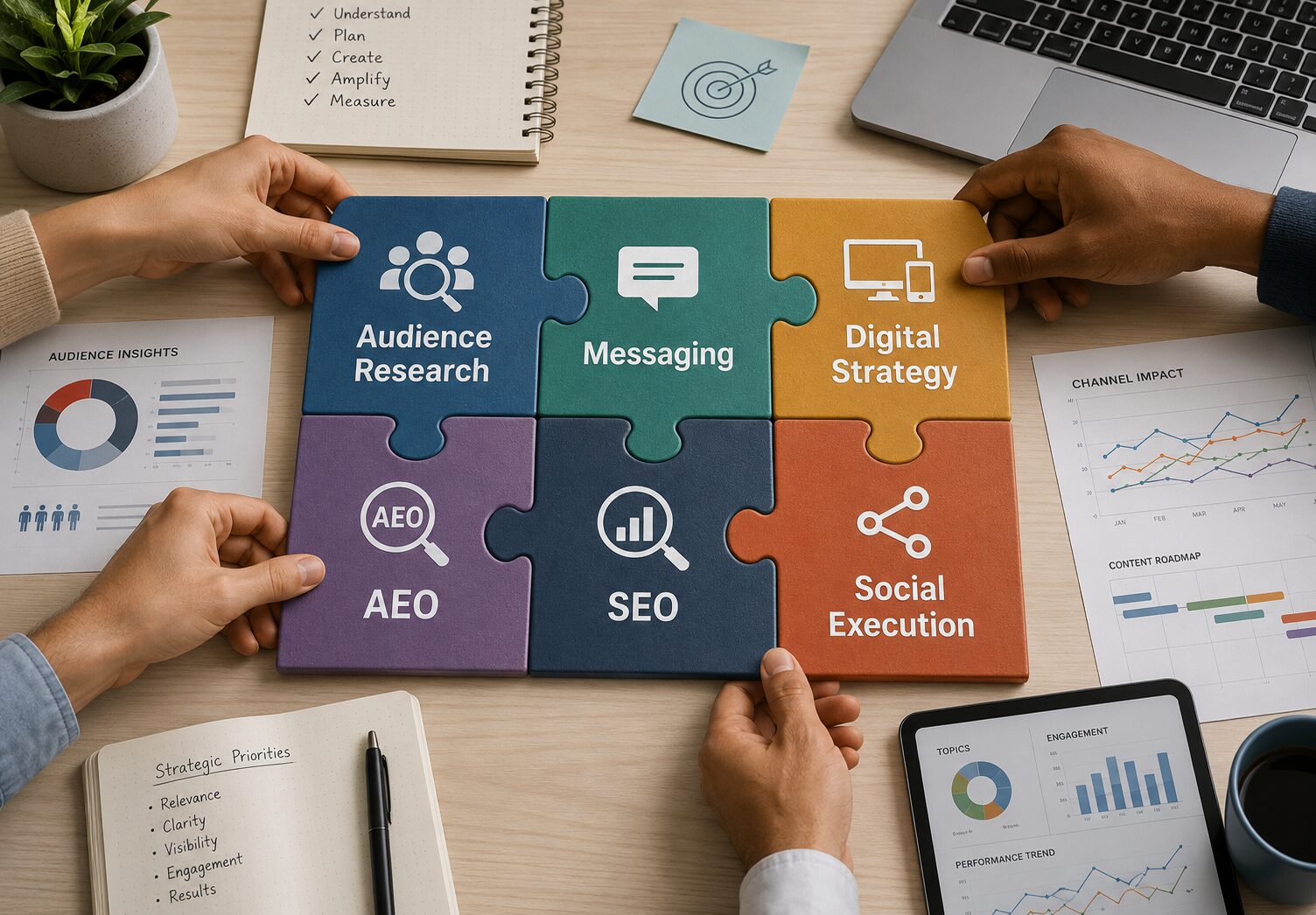
Each of these functions requires a specific kind of thinking that does not naturally live in the same person. A communicator’s job is to understand what the brand is, who the audience is and what message needs to be carried. That is research and positioning heavy work. A digital strategist’s job is to take that message and understand where the audience actually lives online, how to build on SEO as the foundation, how that foundation translates into AEO and how both of those shape whether your brand shows up in AI overviews at all. A social media manager’s job is to take what the digital strategist knows about the audience and translate the brand’s communication into content that fits the platform, the tone and the moment.
Those are three separate lanes and they have to connect in sequence. The communicator sets the foundation, digital strategist builds on it and the social media manager executes from it. When you collapse all three into one person, none of the three get done at the level the current environment demands. The person ends up stretched across responsibilities that each deserve full attention and the work reflects that.
The digital role in particular is one that brands have consistently underestimated. Understanding how to structure content for AI to pick up, how to write for AEO, how to position a brand so the overview points to you rather than a competitor that is a specialized skill that takes real focus to develop and maintain. You cannot hand it to someone who is also managing the Instagram calendar and writing press releases. Something will always suffer and right now what suffers is the thing that matters most.
If your brand is not structured this way, the gap will show up in the results. Not because the people you have are not capable, but because the model you built around them was never designed for what search has become.
Frequently Asked Questions
How does AI search affect brand visibility?
Visibility is no longer tied to how well your site is ranked in a list. It is tied to whether your content is valuable enough for the AI to pull from and whether the user it surfaces to is already inside a bubble where your brand is relevant. Brands that have coasted on equity alone are going to feel this harder than anyone, because the algorithm does not care how long you have been around or how recognizable your name is. It cares about what you actually provide and whether that matches what someone is actively looking for.
What is an AI overview in Google search?
An AI overview is a generated summary that appears at the top of Google search results before any links appear, pulling from multiple sources to deliver a direct answer based on what Google determines your search intent to be. For users, that experience is efficient and fast. For the sites that contributed the underlying information, it can mean exposure without traffic, because the user already has their answer and the motivation to click through to a source disappears.
Why is organic search traffic declining?
The answer now lives inside the search result itself, which means AI overviews satisfy the query before the user ever reaches your site. Layer personalization on top of that and you have a system that not only answers the question but filters results toward what the user has already shown interest in, leaving brands outside that filter invisible by default. If your brand was not part of someone’s search world before this shift took hold, the algorithm has no mechanism to introduce you now.
How should marketers adapt to AI search?
Start with an honest assessment of what your brand actually provides and whether that value is clearly communicated in your messaging, then stop measuring success in impressions and start measuring it in conversions. Do consistent audience research on a monthly schedule rather than treating it as a one-time deliverable and build presence in the places your audience already lives so that your brand is part of their existing behavior before the algorithm has a chance to make you invisible.
What is an algorithmic bubble in search?
An algorithmic bubble forms when a platform learns your preferences and begins filtering out everything that falls outside of them, creating a search experience that reinforces what you already engage with rather than exposing you to something new. Social media has operated this way for years with well-documented consequences for how people consume information. What is different now is that it is happening inside search, which used to be the one place where discovery was still reasonably open and unpredictable. For brands that were not already inside someone’s content world before this shift, the window to break in is closing in a way it never has before.
Is content marketing still worth doing?
Content marketing is worth doing, but not the way most brands have been approaching it. Random content, trend chasing and producing volume for its own sake are strategies that this update has made obsolete. What works now is content that delivers real, specific value on topics your audience is actively searching for, because if your content is genuinely useful, the AI overview does not kill your opportunity. It creates a user who wants more and that want is the conversion that actually matters. The brands still treating content as a numbers game are the ones who will fall furthest behind.
I am an executive communications strategist with experience in government, media and corporate organizations. I write about AI, the workforce and what responsible communication looks like when technology moves faster than people are ready for.