On June 22, Valve released information about the Steam Machine. The console will be starting at $1,049 for the base model; that price surprised a lot of people who had been waiting on additional information about launch and price for months. Nine days later on July 1, Sony dropped a bigger bombshell, announcing that physical disc production for new PlayStation games will stop entirely in January 2028. Both announcements sent ripples into the gaming world. These two announcements represented two things. The first is the impact that AI has on gaming. The second is home console makers are trading away what made them different for tighter control over digital rights and that trade is a mistake.
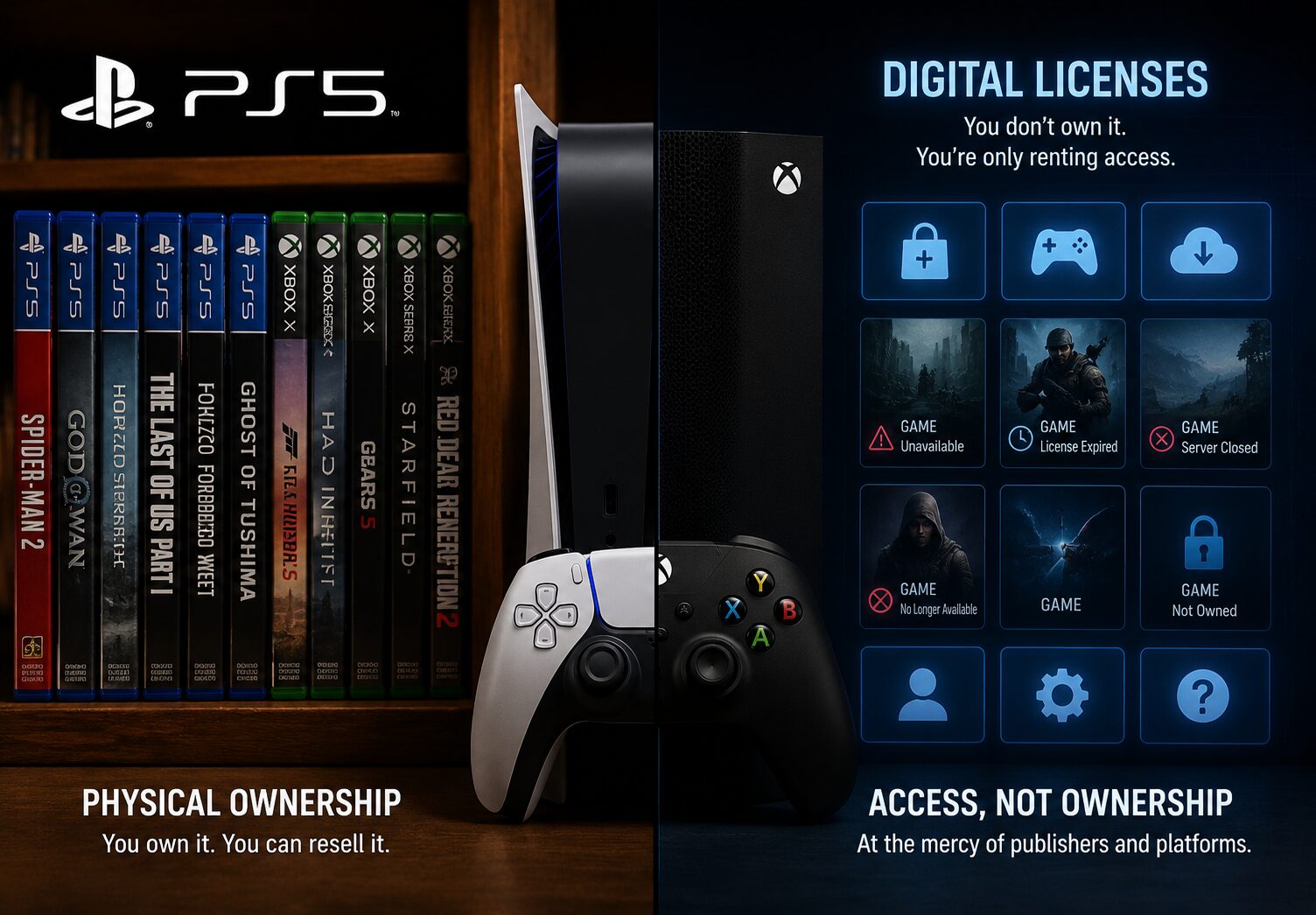
Going fully digital will not save PlayStation, Xbox or Nintendo the way leadership expects. Discontinuing physical games, strips away the ownership. This separated consoles from PC gaming for decades. PC users had no physical ownership and they were fine with that. This is why Valve’s Steam became so successful because their company catered to the PC user. Where consoles were known for their physical copies. However now that consoles like Sony want to go digital that presents a problem with many consumers. Digital entitlement is the industry term for what a buyer actually receives when a game has no disc attached to it. It is a license tied to an account and a platform, not ownership of the game itself and that license can be revoked if a publisher closes its servers or a platform decides not to honor it. This means buyers of games are not owners of the game but renters and renters have less reason to stay loyal.
Why Did Valve Price the Steam Machine So High?
Valve could have taken a loss on the Steam Machine the way Sony and Microsoft on their consoles and make it back on game sales later. It chose not to and $1,049 for the base model is the result of that decision. Memory, storage and chip prices have climbed fast because AI is using the same components consoles depend on and Valve pointed straight at that shortage instead of pretending it was not a factor. There was a leak a few weeks ago about the PlayStation 6 and its price being $960, up from $760 only months earlier; this was driven mostly by memory that AI hyperscalers are buying up faster than manufacturers can produce it. Every hardware maker touching chips, RAM or storage is absorbing the same cost pressure right now, which means the Steam Machine price is not a Valve problem but an industry wide problem that Valve happened to be transparent about.
Why Is PlayStation Ending Physical Disc Production?
Sony says ending physical disc production in January 2028 reflects consumer preference for digital media, not a cost decision tied to chip prices. Whatever the stated reason, the outcome for the buyer is identical either way. Losing the disc means losing a permanent copy and gaining a license instead, on a platform where digital rights have already worked against buyers when infrastructure comes down.
Nintendo is already facing pushback over the Switch 2 for a related reason. Some cartridges sold with the console function as game key cards, meaning the card itself acts as a license that triggers a download to internal storage rather than holding the full game. Microsoft is reportedly building a similar bridge for its next generation console, codenamed Xbox Helix, through a disc-to-digital program internally called Positron. Installing a compatible Xbox One or Series X disc would attach a full digital entitlement to the buyer’s Microsoft account, but that entitlement stays tied to the disc rather than the buyer, so selling or giving away the disc later hands the digital rights to whoever ends up holding it next. Microsoft is reportedly framing Positron as a way to avoid the exact backlash Sony is now facing, which is itself an admission that going fully digital carries real reputational risk. Three different companies, three different mechanisms, one shared destination.
What You Actually Own When You Buy a Game Digitally
A digital purchase does not actually make you own the game. You get access to it for as long as the publisher and the platform decide to let you have it and that difference stays invisible right up until a server shuts down or a platform quietly stops honoring a purchase you already paid for. Publishers including Ubisoft have reportedly cut off access to portions of purchased games when supporting infrastructure came down and a buyer who paid eighty dollars for the game had no recourse when it happened.
That risk is not theoretical anymore but it has become a pattern. A disc once purchased, works regardless of what the publisher decides to do with its servers years later. A license does not carry that guarantee and the industry is asking gamers to give up that guarantee at the exact moment console prices are climbing toward $1,000 or more.
How the Industry Talked Itself Into This
Publishers spent the 2000s upset that GameStop was making real money off used copies of games they only got paid for once. They developed ways to try to mitigate the resale of games. One way was one-time codes locking DLC to the original buyer, then online passes charging a fee just to play multiplayer on a used disc, then DRM that made copying or reselling a game harder outright. Nobody called any of it a digital rights strategy at the time; it was just publishers trying to fix a problem. Full digital distribution finishes what those used game restrictions started and it hands publishers the complete control over licensing they wanted from the beginning.
Publishers wanted revenue from secondhand sales they were being cut out of entirely. Consoles wanted tighter control over the license attached to every game. DRM was the tool that pushed both goals toward the same outcome and full digital distribution is simply that same goal but finished.
What Made Consoles Different From Steam
Steam earned its digital-only reputation honestly; it grew out of an actual gap, PC gamers had no console option, no unified place to buy or manage games and Valve built one from nothing. Consoles never had that excuse. They built their identity on exclusive titles you could not get anywhere else, on a disc you could lend or trade to a friend, on local multiplayer nights that a license agreement cannot replicate. Strip those things away one at a time and the reason anyone chose a console over a PC goes with them.
PC gamers accepted a fully digital library because platforms like Steam were designed around that model from day one. Console buyers were never given that same framing. They were sold instruction manuals, strategy guides and a disc they could hold, lend or resell and now that same buyer is being asked to accept a PC style license without ever being told why the console experience changed underneath them.
Why This Strategy Could Backfire
When a console and a gaming PC cost close to the same amount; both sell games as digital licenses, a console no longer holds a meaningful ownership advantage over a Steam account. There was a rumor earlier this year that the price of the PlayStation 6 will be $960, well above earlier estimates of $700 dollars. That price erases the last practical argument for choosing a console instead of a PC built around the platform that pioneered this model honestly.
The backlash already proves the risk is real; according to Forbes contributor Paul Tassi Sony’s decision as the platform’s biggest scandal in two decades, comparing the reaction to the outrage that followed Sony’s $600 PlayStation 3 launch price back in 2006. Sony has not walked the decision back. Reports indicate at least one disc manufacturing plant is already being converted to other uses, which signals the company is treating this as final rather than something fans anger might reverse. Past controversies Sony did reverse under pressure but this time they are staying the course. I think they will reverse later when they realize customers quietly walk toward Steam.
When it comes to people who purchase items, they do not sign up to pay more for less. A PlayStation priced like a Steam Machine is not offering anything a Steam account does not already have and it is offering less such as: fewer places to actually buy from, no real flexibility and a license standing in for something you used to own outright. A buyer sitting on an existing Steam library looks at that trade and just walk away. Steam built its reputation on frequent sales, an open platform and a library that a user actually controls and every restriction a console adds only strengthens that comparison.
The PSP Go Already Proved This Does Not Work
Sony already tried an all-digital console once with the PSP Go and loyal buyers who purchased it reportedly watched support fade within six to eight months of launch. History suggests that consumers will follow a trusted brand into an all-digital model on faith, but that faith does not survive a lack of long-term commitment and it will not survive a second failed attempt.
Those precedent matters because trust once spent, is difficult to rebuild. If the current transition fails for PlayStation, Xbox or Nintendo the way it reportedly failed for the PSP Go, returning to physical media later will not simply restore the relationship. Buyers who felt burned once tend to remember and a company that already looks like it prioritized licensing control over its own customers are not looked at as favorable.
The Bottom Line
Consoles did not lose their identity to Steam; they gave it away one restriction at a time. Starting with the fight over GameStop and ending with a disc production shutdown that removes the last physical thing a buyer could hold. Steam never had to take market share by force, because every decision a console maker made to protect licensing revenue also erased the reason someone chose a console over a PC. The Steam Machine price shock and the PlayStation disc announcement are not two separate stories. They are the same story, told nine days apart and it ends with consoles competing on Steam’s terms instead of their own.
Frequently Asked Questions
Why did the Steam Machine cost more than expected?
Valve tied its pricing to rising memory, storage and chip costs driven by AI data center demand and refused to sell the hardware at a loss the way console makers typically do.
What happens to a digital game if a publisher shuts down its servers?
The buyer can lose access entirely, since a digital purchase is a license rather than ownership and publishers including Ubisoft have reportedly restricted access to purchased content this way.
Is Sony ending physical discs because of AI chip costs?
No. Sony’s stated reason is a shift in consumer preference toward digital media, though the broader industry is separately dealing with AI driven chip and memory cost pressure and a leaked PlayStation 6 manufacturing cost of $960 reflects that same pressure.
What is Xbox’s Positron program?
Positron is Microsoft’s reported disc-to-digital program for its next generation console, codenamed Xbox Helix, that would convert an installed physical disc into a full digital entitlement, though that entitlement stays tied to the disc rather than the original buyer.
Has an all-digital console failed before?
Yes. Sony’s PSP Go was an all-digital device that reportedly lost support within six to eight months, a precedent that raises real doubt about repeating the same model industry wide.
I am an executive communications strategist with experience in government, media and corporate organizations. I write about AI, the workforce and what responsible communication looks like when technology moves faster than people are ready for.