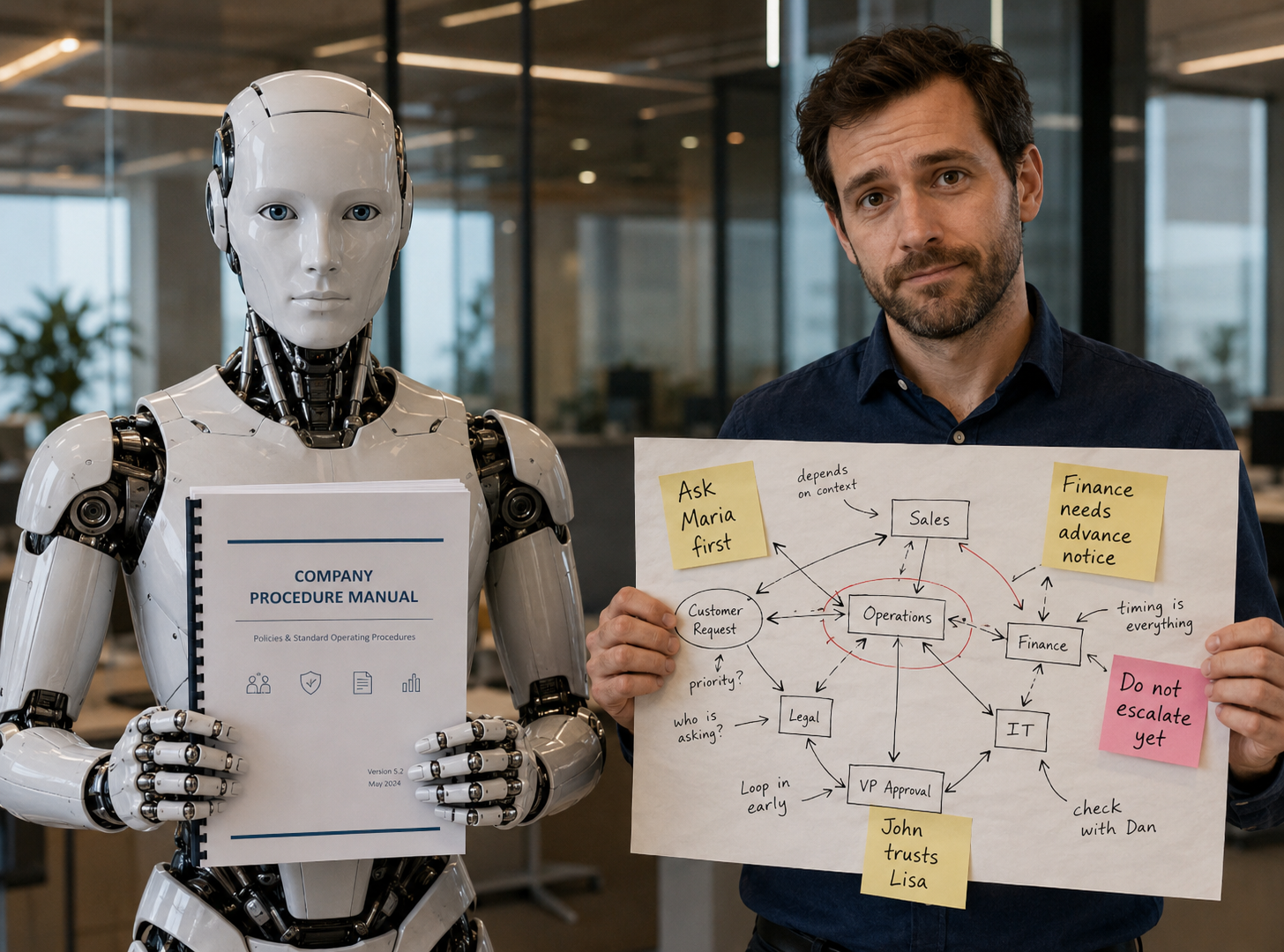
Companies that have replaced employees with AI agents are now running into a problem. The agent is not performing as expected. They are realizing that the employee had something the agent did not: institutional knowledge and relationships. When people think of institutional knowledge, they think of knowing things that are not documented within the company, and that is partially true. But it also includes navigating people and social dynamics.
Why Surveillance Cannot Replace Trust
Companies think they can solve this by monitoring employees’ work through keystrokes and cameras. Institutional knowledge is not just about skill; there is more to it than that. It’s that tacit knowledge of tact and judgment, relationship building, social capital, and social tactic. These things cannot be duplicated by AI, because they are a part of the employee skill inventory. This is where the misunderstanding and underestimating of what an employee actually does come into play.
What Leadership Is Starting To Realize
Relationships earn trust, and with the earning of trust, AI cannot own that. Once a person leaves a company, the relationships they built leave with them, along with the ability and context they use to complete tasks. Tasks are nonlinear and if tasks were linear, AI could perform a job with no problems. When things pop up such as issues of incomplete work, human emotions, illness, burnout, power dynamics and situations that require you to break down the pros and cons of an issue to get leadership to make a decision. These are things AI cannot do. AI can store data and pull it fast, but it does not know the context in which the data can be used. The human aspect is a powerful thing and some leadership is starting to realize that.
Frequently Asked Questions
- Why are companies struggling after replacing employees with AI agents?
Companies are finding that AI agents underperform because they lack institutional knowledge, meaning the undocumented understanding of how to navigate people, relationships, and social dynamics within an organization. - What is institutional knowledge, and why does it matter?
Institutional knowledge is more than technical skill or documented processes. It includes tacit knowledge like judgment, tact, relationship building, and social capital, things employees develop over time that cannot be written down or transferred to an AI system. - Can AI replace the relationships an employee builds at work?
No. Relationships are built on trust, which is earned over time through human interaction. When an employee leaves, those relationships, along with the access and context they provided, leave with them. AI cannot own or replicate that trust. - What can AI not do that human employees can?
AI can store and retrieve data quickly, but it does not understand the context in which that data should be used. It also cannot weigh the pros and cons in ambiguous situations to help leadership make nuanced decisions.
I am an executive communications strategist with experience in government, media and corporate organizations. I write about AI, the workforce and what responsible communication looks like when technology moves faster than people are ready for.